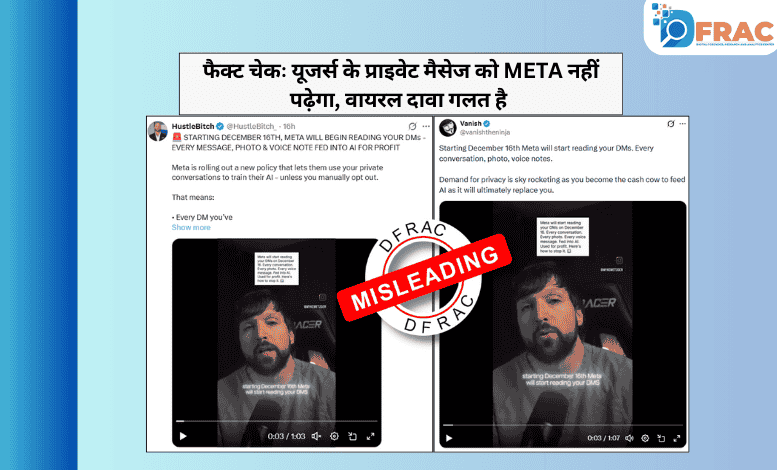
The Viral Claim: Unpacking the Fear Around Meta Private Messages
A disturbing claim has been circulating online, causing widespread alarm among users of Meta's platforms like Facebook, Instagram, and WhatsApp. The viral posts suggest that from December 16, 2024, Meta would begin scanning and using users' private messages (DMs), photos, and voice notes to train its Artificial Intelligence models for profit. Many users have expressed outrage, believing that Meta was introducing a new policy that would allow it to "read your DMs – every message, photo, and voice note will be fed into AI for profit." The posts further claimed that this new policy would apply to "every private chat with friends, family, partners, and clients," including messages sent to you, and that the opt-out process was deliberately made "confusing and desktop-only" to prevent most people from exercising their privacy rights. This narrative painted a picture of an immediate, intrusive threat to the sanctity of Meta private messages, leaving many to question their trust in the tech giant.
The urgency conveyed by the "December 16" date, combined with the sensitive nature of private conversations, fueled rapid sharing of this misinformation across various social media platforms. The idea that deeply personal interactions could be harvested for commercial AI training without explicit, easy consent struck a raw nerve, tapping into pre-existing anxieties about data privacy in the digital age. But is this alarming scenario truly what Meta has planned for your inboxes?
Fact Check: What Meta's 2025 Privacy Policy *Actually* Says
Our investigation into these viral claims reveals a critical distinction that fundamentally alters the narrative. The DFRAC team's fact-check confirmed that while Meta indeed has a new privacy policy coming into effect on December 16, the year stated in the viral claim is incorrect. The policy update in question is set to take effect on December 16, 2025, not 2024. This crucial detail immediately pushes back the timeline and reduces the sense of immediate panic.
More importantly, the focus of Meta's proposed privacy update has nothing to do with Direct Messages (DMs) between individual users. The update exclusively pertains to how Meta uses data from conversations with its generative AI features, specifically Meta AI. This means the changes are designed to clarify the use of data generated when you interact directly with Meta's AI chatbot, not to access or process your private, one-on-one chats with other people. The distinction between a user's direct interaction with an AI chatbot and their private conversations with other humans is paramount to understanding this policy.
Key Details from Meta's Official Statements:
On October 1, 2025, Meta announced its upcoming privacy policy update. According to their official statements, the primary changes are:
- Personalization of Content & Ads: Meta will begin personalizing content and advertisement recommendations on its platforms based on people’s conversations with its generative AI features. This means if you chat with Meta AI about, for example, "new running shoes," you might see more relevant ads or content related to running shoes on your feed.
- Notification Process: Users will be notified about this update via in-product notifications and emails starting October 7, 2025, several weeks before it takes effect. This phased notification approach aims to ensure users are aware of the changes well in advance.
- User Controls: Meta explicitly stated that users retain control over their experience through tools like "Ad Preferences" and other feed controls, allowing them to adjust the content and ads they see at any time.
Media reports from various sources, including Navbharat Times and Hindustan, corroborated that the policy change centers on using data from conversations between users and Meta AI to tailor advertisements across platforms like WhatsApp, Facebook, and Instagram. Furthermore, a conversation with Trushar Barot, Meta India’s Strategic Partner Development Head, confirmed the factual inaccuracy of the viral claim concerning private messages.
It is vital to understand that Meta's new policy focuses on your active engagement with its AI, treating those interactions similarly to how your public posts or likes might inform content recommendations. Your private messages between individuals remain distinct and are not subject to this specific AI training data policy. This clarifies that the concerns regarding Meta reading your private messages for AI training from December 16 are unfounded, as the policy applies to AI chats and takes effect in 2025.
Why the Misinformation Spreads: Trust, AI, and Your Private Messages
The rapid spread of this particular misinformation highlights several underlying factors prevalent in the digital landscape. Firstly, there's a general, and often justified, skepticism towards large tech companies regarding their data handling practices. Past privacy controversies have eroded public trust, making users more susceptible to alarming claims about data exploitation. Secondly, the rapid advancement of Artificial Intelligence is both fascinating and intimidating. Many users don't fully understand how AI works, leading to a "black box" perception where the unknown can easily be filled with worst-case scenarios, such as AI indiscriminately sifting through private data.
The viral claim expertly leveraged these fears by focusing on the most personal form of digital communication: private messages. The notion that "every DM you send" could be fed into AI for profit taps into deep-seated concerns about surveillance and the commercialization of intimacy. The mention of a "confusing and desktop-only opt-out process" further fueled distrust, portraying Meta as deliberately trying to trick users into giving up their privacy. This narrative is incredibly potent because it plays on the feeling of helplessness against a powerful corporation. Understanding this distinction is critical for safeguarding your Meta private messages from unwarranted worry.
However, it's crucial to differentiate between general privacy concerns (which are valid and ongoing) and specific, factually incorrect claims. Meta's platforms, particularly WhatsApp, employ end-to-end encryption for private messages by default, meaning that the content of these messages is secured from Meta itself and third parties. While other Meta platforms like Messenger have offered end-to-end encryption as an opt-in feature, the core principle is that these private conversations are intended to be just that – private. The technical architecture, as hinted at in developer discussions (where private messages are often distinguished by a specific 'archetype'), supports the idea that DMs are fundamentally different from public posts or interactions with a chatbot.
Safeguarding Your Privacy: Beyond the Myth
While the immediate panic regarding Meta's 2025 update and your DMs is largely unfounded, managing your digital privacy remains a crucial responsibility. Here are some actionable steps and considerations to help protect your information on Meta platforms:
- Understand End-to-End Encryption: Be aware of which communication channels offer end-to-end encryption. WhatsApp uses it by default for all messages and calls. Messenger offers opt-in end-to-end encrypted chats (Secret Conversations), though not for all conversations by default yet. When enabled, this encryption ensures that only the sender and recipient can read or listen to the content.
- Review Privacy Settings Regularly: Meta platforms provide extensive privacy settings. Take the time to review who can see your posts, photos, and personal information. Adjust settings to restrict visibility to "Friends" or "Only Me" where appropriate.
- Manage Ad Preferences: Even if your DMs aren't being scanned for AI training, Meta does use other data (like your activity, pages you like, and demographic information) to personalize ads. Regularly check your "Ad Preferences" to understand what data is being used and to adjust your interests or hide specific advertisers.
- Be Mindful of AI Interactions: If and when you engage with Meta AI, remember that those conversations can be used to improve the AI and personalize your experience. Treat interactions with AI as you would any public forum or service interaction – avoid sharing sensitive personal information.
- Enable Two-Factor Authentication (2FA): This adds an extra layer of security to your accounts, making it much harder for unauthorized individuals to gain access, even if they have your password.
- Stay Informed from Reputable Sources: Before reacting to viral claims, always cross-reference information with official announcements from Meta or established fact-checking organizations. This helps distinguish legitimate privacy concerns from misleading narratives.
The specific "opt-out" process mentioned in the viral claim, which was described as confusing and desktop-only for DMs, is moot given that the policy doesn't apply to DMs in the first place. However, understanding how to manage your data for Meta AI interactions will be relevant for users who choose to engage with those features. Always look for official guidance from Meta regarding any data usage opt-outs.
In conclusion, the alarming claims about Meta reading your private messages to train its AI from December 16 are based on a misunderstanding of both the date and the scope of Meta's upcoming privacy policy. While December 16, 2025, will see changes, these will pertain exclusively to how Meta uses data from your direct interactions with its generative AI features, not your personal DMs with other users. It's a vital reminder to always fact-check information, especially concerning sensitive topics like digital privacy, and to proactively manage your settings to ensure your comfort and security on social media platforms.